
How Micro-Heatwaves Disrupt Global Supply Chains
As extreme localized triple-digit heatwaves become a permanent fixture of global weather patterns, economists and logistics planners face a hidden driver of persistent inflation that slips entirely under traditional meteorological tracking.

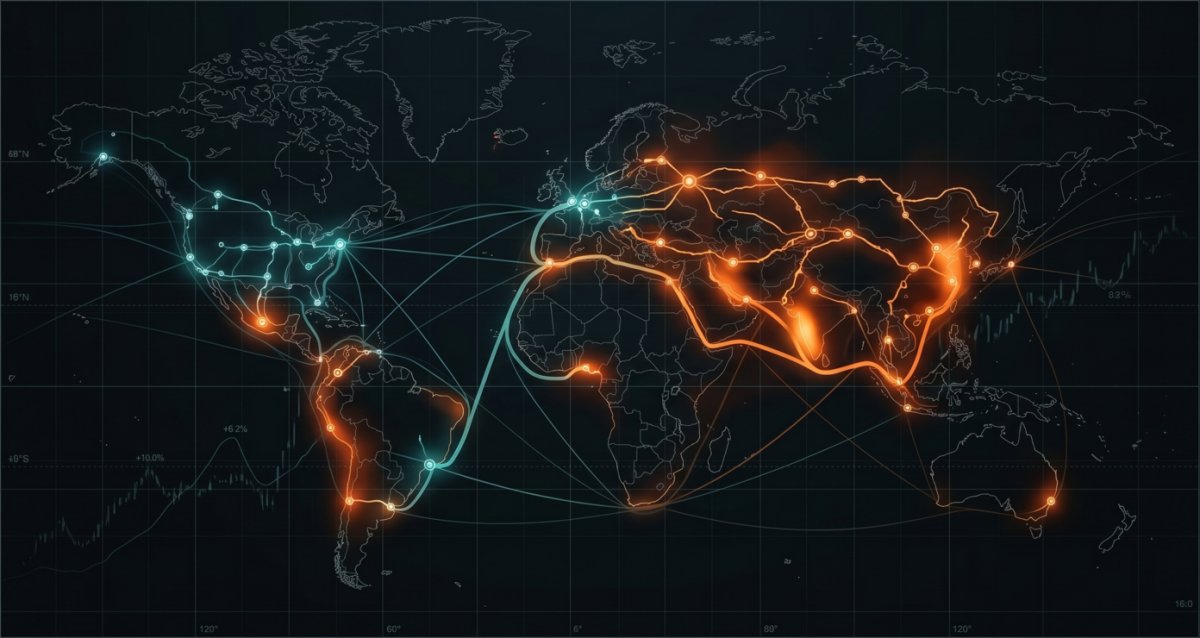
For years, the standard macroeconomic playbook treated weather-related economic shocks as temporary, seasonal anomalies. If a severe frost hit the agricultural belt or a late-season hurricane disrupted refinery operations along a major coastline, prices would spike briefly, supply chain networks would recalculate, and the market would steadily return to equilibrium. Traditional central banking frameworks assumed that while climate events could trigger localized volatility, they lacked the systemic structural power to drive long-term, sticky inflation.
That baseline assumption is failing. Central banks, multinational corporations, and international logistics networks are confronting a subtle, highly destructive economic phenomenon: The Climate Inflation Paradox.
The paradox lies in a fundamental misalignment between traditional macroeconomic tracking and real-world industrial reality. While headline economic indicators look for large-scale, country-wide catastrophes to explain market friction, the true driver of modern inflationary pressure is highly localized. Extreme micro-climate heatwaves and sudden, isolated triple-digit temperatures are quietly warping the underlying mechanics of international trade and asset management.
The Anatomy of Micro-Climate Heat Disruption
Unlike broad regional seasonal shifts, a micro-climate heatwave is a hyper-localized phenomenon. It occurs when a highly specific geography—often an essential logistical choke point, a localized agricultural valley, or an industrial processing hub—experiences a sudden, severe spike in temperature that completely detaches from the wider regional average.
When these isolated pockets face sustained triple-digit heat, the economic consequences immediately ripple across three primary industrial channels:
-
The Evaporation of Historical Agricultural Donor Bases: Specialized cash crops and high-yield agricultural valleys depend on precise, micro-climate thermal bands to survive. When hit with sudden triple-digit heat spikes, these localized donor bases dry up instantly. The crop loss isn't broad enough to qualify as a national drought disaster, but it is severe enough to trigger sharp, immediate food commodity inflation on regional exchanges.
-
Thermal Overload on Inland Transport Logistics: Steel rail networks and heavy asphalt transport corridors are engineered to tolerate specific, predictable regional temperature ranges. Extreme micro-climate heatwaves alter this calculus. Sustained triple-digit surface exposure leads to thermal expansion, causing rail lines to warp (known as "sun kinks") and asphalt to soften. To prevent catastrophic derailments or infrastructure damage, logistics networks are forced to enforce mandatory speed restrictions and reduce maximum axle loads, slumping the velocity of freight movement.
-
The Inland Waterway Depletion Matrix: Major industrial rivers serve as the primary heavy freight arteries for bulk commodities like grain, steel, and coal. When isolated heat domes park directly over key river feeding basins, water levels drop at unprecedented rates, compressing barge load capacities and forcing massive shipping backlogs.
                      [ MICRO-HEATWAVE MULTIPLIER MATRIX ]
                                       │
        ┌──────────────────────────────┼──────────────────────────────┐
        ▼                              ▼                              ▼
[ INFRASTRUCTURE RISK ]       [ FREIGHT CAP CAPACITY ]       [ PREMIUM SURCHARGES ]
Rail thermal warping           Barge low-water restrictions   Emergency asset rerouting
Asphalt surface softening      Aircraft hot-weather weight    Spiking spot-market freight
Forced velocity drops          Compromised transit volume     Sticky consumer price hikes
The Hidden Drag on Aviation Cargo
The operational friction caused by micro-climate heatwaves extends all the way into air freight networks. Long-distance air logistics centers rely heavily on predictable air density to safely launch massive, fuel-heavy cargo aircraft. As hot air expands, it becomes less dense, drastically reducing the aerodynamic lift generated by an aircraft's wings.
When a vital regional air hub experiences unseasonal, triple-digit temperatures, ground operations face immediate physical limits. Aircraft cannot generate the necessary lift to take off safely on standard runway lengths under maximum load parameters. To adapt, cargo carriers are forced to implement "payload restrictions"—arbitrarily stripping away thousands of pounds of high-value freight or offloading fuel reserves to clear the runway safely.
To offset the immediate loss of cargo volume, carriers naturally implement emergency capacity surcharges, passing the economic premium directly down the supply chain until it finally embeds itself in consumer retail pricing.
Rethinking Corporate Strategic Insurance
The fundamental danger of the Climate Inflation Paradox is that its root causes are routinely misdiagnosed. Because these extreme heat events are localized, swift, and highly distributed, traditional corporate risk models often mistake the resulting price increases for standard market fluctuations or temporary labor friction. As a result, businesses fail to structurally adapt their underlying infrastructure, opting instead to repeatedly absorb higher spot-market transport costs.
Breaking out of this inflationary cycle requires a complete overhaul of global supply chain planning. Corporate logistics strategies can no longer rely on hyper-lean, "just-in-time" inventory systems that assume a frictionless, thermally stable world.
To survive this fragmented climate landscape, resilient enterprises are shifting toward a "just-in-case" architecture—intentionally building deeper geographic redundancy into their donor bases, investing in high-temperature logistics corridors, and treating micro-climate thermal tracking as an essential macroeconomic forecasting tool. Until this structural shift occurs, the hidden tax of micro-climate inflation will continue to quietly erode corporate margins and drive consumer prices relentlessly higher.
What's Your Reaction?
 Like
0
Like
0
 Dislike
0
Dislike
0
 Love
0
Love
0
 Funny
0
Funny
0
 Wow
0
Wow
0
 Sad
0
Sad
0
 Angry
0
Angry
0







Comments (0)